TEXT BERJALAN BOLAK BALI
Tampilkan postingan dengan label WRITING. Tampilkan semua postingan

Jumat, 29 Mei 2015

Writing - How to write a job application

How to write a job application

You will need to apply in writing for most jobs. This usually means preparing two items, a letter of application and your resume.  If you are applying for a government job, you may need to provide responses to some selection criteria.
We have developed this guide to provide you with information to prepare a letter of application.  To read the how to guide on building a resume, visit:
  • How to build a resume
For ideas on how to present your resume if you have gaps in your work history, see:
  • Applying for a job when you have an episodic work history

Written applications

Written applications generally are a key part of an employer’s recruitment process. Employers use recruitment processes to select who they should interview for a job by assessing skills, qualities, experience and qualifications. Some employers will also use recruitment processes to identify writing skills if these are important to the job.
  • ensure you research the employer and the position you are applying for
  • identify skills, attributes, knowledge, experience and qualifications which will appeal to the employer

Cover letter

Many employers are very busy, so the cover letter needs to be concise.

What to include

  • Customise your cover letter so it is relevant to the employer and the job.
  • Focus on what the employer wants to know, not what you want from them.
  • Try to convince them that you can do the job, that you’ll do a great job, you’ll fit in and be an asset to their organisation.
  • Make sure you include your contact details.
  • Keep your letter no longer than one page.

Structure

Explain the purpose of your letter in the opening paragraph. Mention the position you are applying for and where you heard about it or where it was advertised. 
In the next paragraph, show you can do the job and do it well. You should summarise your qualifications, skills, abilities and experience. State what makes you perfect for the job advertised.
Next, state that you are keen to work for the company and why. Try to give some information about what type of person you are. Keep in mind what you know about the employer. Mention your personal qualities which you think they are looking for.
Before finishing, thank them for taking the time to review your application. Also mention any attachments including your resume and any work examples.

Final check

Check your application before sending it. Ask someone else to check it for mistakes. Ensure that you have read the job advertisement and any other information. Check if the employer asked you to send several copies of your application. Some employers may want you to address specific selection criteria.
You should also complete the following check:
  • Don’t send too much. Employers are very busy and will not want information they haven’t asked for. 
  • Send copies of your original documents. If the employer has requested copies of certificates and other formal documents, only send copies.  You can show them the originals at your interview, if required.
  • Ensure your application is professionally presented as employers pride themselves on their professionalism. They are looking at your application to ensure that you share their values. For example:
    • type your application, unless they specify for you to write it
    • use clean A4 paper
    • don’t make manual corrections, such as crossing something out or using correction fluid
    • make sure it is easy to read. The print must be clear. There should be spaces between paragraphs. Use a suitable font size and appropriate margins.  The print shouldn’t start too close to the top of the page or go too close to the edges or bottom of the page
    • Use an A4 envelope so that you don't have to fold your application
    • use a standard font, nothing too fancy
  • tailor your application to the job you are applying for.  If you are applying for a creative industry job, it might be appropriate to show your creativity.  For most jobs, concentrate on making the application clear, simple and to the point. 
  • number the pages in the application
  • include your name in the header or footer of each page in case they become separated
  • if posting your application make sure you send it in plenty of time, otherwise try and drop it off in person.
http://www.jobaccess.gov.au/content/how-write-job-application

Writing - Write a Cover Letter in 5 Easy Steps

Write a Cover Letter in 5 Easy Steps

A well-written cover letter will help you secure an interview and get your application noticed. Take the time to personalize it so it shows the employer why you're a solid candidate for the job. Here's how to write a cover letter in five easy steps.

Keep it Short
Keep in mind that your cover letter doesn't need to be long - a page is plenty. Here's information on how long a cover letter should be.

Cover Letter Samples
Here are cover letters examples, both written and email, that are designed for a variety of different types of job applications and employment inquiries.

Cover Letter Format
This cover letter format lists the information you need to include in the cover letter you submit with your resume.

More Types of Cover Letters
There are other types of cover letters you may need to use, depending on the jobs for which you are applying. Here are examples of referral letters, prospecting letters, letters asking for job search help and more.

More About How to Write a Cover Letter
How to write a cover letter, including what to include in your cover letter, cover letter format, targeted cover letters, and cover letter samples and examples.

Writing - Job Application Letter Format

 -
The following application letter format lists the information you need to include in the job application letter you send with your resume.
Application letters have a fairly rigid format - as hiring managers read your letter, they will expect to see certain information included in set areas. (The format of an email application letter is similar, but varies slightly from the application format below.)

Use the application letter format below as a guideline to create customized application letters to send to employers.

Job Application Letter Format

Contact Information
Name
Address
City, State, Zip Code
Phone Number
Email Address
Date
Employer Contact Information (if you have it)
Name
Title
Company
Address
City, State, Zip Code

Salutation
Dear Mr./Ms. Last Name, (leave out if you don't have a contact)

Body of Application Letter
The body of your application letter lets the employer know what position you are applying for, why the employer should select you for an interview, and how you will follow-up.

First Paragraph
The first paragraph of your letter should include information on why you are writing. Mention the job you are applying for and where you found the job listing. Include the name of a mutual contact, if you have one.

Middle Paragraph(s)
The next section of your application letter should describe what you have to offer the employer. Mention specifically how your qualifications match the job you are applying for.

Final Paragraph
Conclude your application letter by thanking the employer for considering you for the position. Include information on how you will follow-up.

Complimentary Close
Sincerely,
Signature

Listening - Parts of an Essay

Parts of an Essay

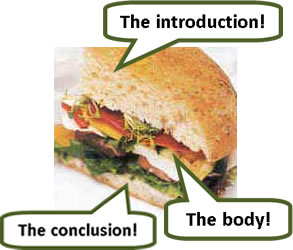
The different parts of the essay are like the parts of a sandwich or a burger...

Essays, like sandwiches or burgers, are divided into different parts. These parts are the:
  • Introduction
  • Body
  • Conclusion

The Introduction

The introduction opens the essay. It is a short paragraph – usually about THREE sentences. In an argument essay, it usually describes or summarizes both sides of the present situation and says what you are going to do in your essay.

The Body

The Body is the main part of the essay. In an argument essay, it is divided into two or three paragraphs, giving your opinion and reasons.
Each paragraph in the body is between FIVE and SEVEN sentences long.

Conclusion

The Conclusion is the end of the essay. It is a short paragraph – about THREE sentences. It often has the same idea as the Introduction, only in different words.
Some people think of the essay as a sandwich. The Introduction and Conclusion are the bread, and the Body is the filling in the center. If the introduction looks good, people will carry on to the body. Hopefully, the conclusion will leave them with a nice taste in their mouth…

http://writefix.com/?page_id=1813

Kamis, 14 Mei 2015

Writing - Punctuation

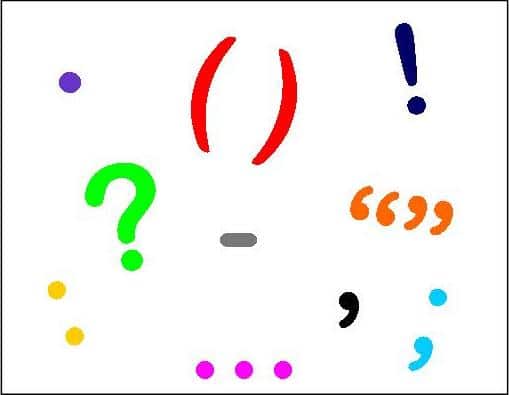
How to Use English Punctuation Correctly

Part 1 of 8: Using Proper Capitalization

1. Always start a sentence with a capital letter. Unless you're an avant-garde poet, you will need to capitalize the first letter of every sentence without exception. Usually, the capitalized form of a letter is just a bigger version of that letter, though there are exceptions (such as "q" and "Q").
  • Here is an example of proper capitalization at the beginning of a sentence:She invited her friend over after school.


2. Use capital letters to start proper nouns and titles. In addition to starting sentences, capital letters should also be at the start of both proper nouns and titles. Proper nouns are the official names of specific people, places, and things. Titles, which are a type of proper noun, refer to the official names of works of art like books, movies, plays, and so on, and of institutions, geographical areas, and much more. Titles can also be honorifics (Her Majesty, Mr. President, etc.).
  • Titles and proper nouns that are more than one word long should have every word capitalized, except for small words and articles like "the," "an," "and," etc. The first word of a title should be capitalized regardless of what it is.
  • Here are a few examples of capital letters being used for proper nouns and titles:
    Genghis Khan quickly became the most powerful man in Asia, if not the world.
    In her opinion, Queen Roberta's favorite museum in the world is the Smithsonian, which she visited during her trip to Washington, D.C., last year.
3. Use capital letters for acronyms. An acronym is a word formed from the first letter of every word in a long proper noun or title. Acronyms are frequently used to shorten long proper nouns that would be awkward to reprint in their entirety every time they are mentioned. Sometimes the letters of an acronym are separated by periods, though this is not always the case.
  • Here is an example of acronyms made from capital letters:
    The CIA and the NSA are just two of the USA's many intelligence agencies.

Part 2 of 8: Using End-of-Sentence Punctuation Marks

1. Use a period (full stop) to end declarative sentences and statements. Every sentence contains at least one punctuation mark - the one at its end. The most common of these sentence-ending punctuation marks is the period (".", also called "full stop"). This simple dot is used to mark the end of a sentence that is declarative. The majority of sentences are declarative - any sentence that states a fact, explains an idea, or describes an idea, for instance, is declarative.
  • Here is an example of a period (full stop) being used correctly at the end of a sentence:
    The accessibility of the computer has increased tremendously over the past several years.
2. Use a question mark to end questions. The question mark ( "?" ), used at the end of a sentence, denotes that the sentence was an interrogative sentence - basically, a question. Use this punctuation mark at the end of all your questions, queries, and inquiries.
  • Here is an example of a question mark being used correctly at the end of a sentence:
    What has humanity done about the growing concern of global warming?
3. Use an exclamation point to end exclamatory sentences. The exclamation point ("!", also called an "exclamation mark" or "shout mark") suggests excitement or strong emphasis in the preceding sentence. The exclamation point is also used, appropriately, to end exclamations - short expressions of intense emotion that are often only one word long.
  • Here are two examples of an exclamation point being used correctly at the end of a sentence:
    I can't believe how difficult the exam was!
    Eek! You scared me!

Part 3 of 8: Using Commas


1. Use a comma to indicate a break or pause within a sentence. The comma (",") is a very versatile punctuation mark - there are dozens of instances that might require you to use a comma in your writing. Perhaps the most frequent use of commas is to imply an appositive - a break within a sentence that supplements and adds information to the subject.
  • Here is an example of commas being used to create a break in a sentence:
    Bill Gates, CEO of Microsoft, is the developer of the operating system known as Windows.


2. Use the comma when listing items in a series. Another very common use for commas is to separate items that are being listed in sequence. Usually, commas are written between each of the items and between the second-to-last item and a conjunction.
  • However, many writers omit the comma before the conjunction (called a Serial comma or "Oxford comma") as conjunctions like "and" can usually make the meaning of the list clear with or without the preceding comma.
  • Here are two examples of commas used in listed series of items - one with an Oxford Comma and one without.
    The fruit basket contained apples, bananas, and oranges.
    The computer store was filled with video games, computer hardware and other electronic paraphernalia.
3. Use a comma to separate two or more adjectives describing a noun. Sometimes, multiple adjectives are used in a row to describe a single subject using multiple qualities. This usage of commas is somewhat similar to using commas to separate items in a series, with one exception - it is incorrect to place a comma after the final adjective.
  • Here are examples of correct and incorrect comma usage when it comes to separating adjectives:
    CORRECT - The powerful, resonating sound caught our attention.
    INCORRECT - The powerful, resonating, sound caught our attention.
4. Use a comma to separate one geographical area from another that is located inside. Specific geographical places or areas are usually named by starting with the most precise location name and then proceeding outwards. For instance, you might refer to a specific city by naming the city itself, followed by the state it is in, followed by the country, and so on. Each geographic descriptor is followed by a comma. Note that commas are also used after the final geographical area if the sentence continues.
  • Here are two examples of correct comma usage when it comes to naming geographical areas:
    I am originally from Hola, Tana River County, Kenya.
    Los Angeles, CA, is one of the largest cities in the United States.
5. Use a comma to separate an introductory phrase from the rest of the sentence. An introductory phrase (which is usually one or more prepositional phrases) briefly introduces the sentence and provides context, but is not part of the sentence's subject or predicate. Therefore, it should be separated from the main clause by a comma.
  • Here are two examples of sentences with introductory phrases separated from the rest of the sentence by commas:
    After the show, John and I went out to dinner.
    On the back of my couch, my cat's claws have slowly been carving a large hole.
6. Use the comma to separate two independent clauses. Having two independent clauses in a sentence simply means that you can split the sentence into two separate ones while preserving the original meaning. If your sentence contains two independent clauses that are separated by a conjunction (such as and, as, but, for, nor, so, or yet), place a comma before the conjunction.
  • Here are two examples of sentences containing independent clauses:
    Ryan went to the beach yesterday, but he forgot his sunscreen.
    Water bills usually rise during the summer, as people are thirstier during hot and humid days.
7. Use a comma when making a direct address. When calling one's attention by saying their name at the start of a sentence, separate the person's name and the rest of the statement with a comma. Note that this comma is somewhat rare to encounter in writing because this is something that is normally only done while speaking. In writing, it's more common for the writer to indicate who is speaking to whom via other methods.
  • Here is an example of a direct address:
    Amber, could you come here for a moment?
8. Use a comma to separate direct quotations from the sentence introducing them. A comma should come after the last word before a quotation that is being introduced with via context or description provided by the rest of the sentence. On the other hand, it is not necessary to use a comma for an indirect quote - in other words, if you are paraphrasing a quote's meaning without recreating the precise wordage. Additionally, a comma is usually not necessary if you are not quoting an entire statement, but only a few words from it.
  • Here is an example of a direct quotation that requires a comma:
    While I was at his house, John asked, "Do you want anything to eat?"
  • Here is an example of an indirect quotation that does not require a comma:
    While I was at his house, John asked me if I wanted anything to eat.
  • Here is an example of a partial direct quotation, which, due to its brevity and its use within the sentence, doesn't require a comma:
    According to the client, the lawyer was "lazy and incompetent."

Part 4 of 8: Using Colons and Semicolons

1. Use a semicolon to separate two related but independent clauses. The proper use of a semicolon is similar, but not identical, to that of a period. The semicolon marks the end of one independent clause and the start of another within a single sentence. Note that, if the two clauses are very wordy or complex, it is better to use a period (full stop) instead.
  • Here's an example of a semicolon being used correctly:
    People continue to worry about the future; our failure to conserve resources has put the world at risk.
2. Use a semicolon to separate a complex series of items. Usually, the items in a written list are separated by commas, but for lists in which one or more items require comment or explanation, semicolons can be used in conjunction with commas to keep the reader from becoming confused. Use semicolons to separate items and their explanations within the list from one another - to separate an item from its own explanation and vice versa, use a comma.
  • Here's an example of semicolons being used correctly in a list whose meaning might otherwise be ambiguous:
    I went to the show with Jake, my close friend; his friend, Jane; and her best friend, Jenna.
3. Use the colon to introduce a list. Be careful, however, not to use a colon when stating an idea that requires naming a series of items. The two are similar, but distinct. Usually, the words following or "below" suggest the use of a colon. Use only after a full sentence which ends in a noun.
  • Here's an example of a colon being used correctly in this fashion:
    The professor has given me three options: to retake the exam, to accept the extra credit assignment, or to fail the class.
  • Here, on the other hand, is an incorrect example:
    The Easter basket contained: Easter eggs, chocolate rabbits, and other candy.
4. Use a colon to introduce a new concept or example. Colons can also be used after a descriptive phrase or explanation to imply that the next piece of information will be the thing being described or explained. It can help to think of this as introducing a list containing only one item.
  • Here's an example of a colon being used properly in this way:
    There's only one person old enough to remember that wedding: grandma.
5. Use a colon to separate parts of a title. Some works of art, particularly books and movies, can have long, subdivided titles. In these cases, each title after the first is called a subtitle. Use colons at the end of each "part" of the title to separate each subtitle from the rest of the title.
  • Here's an example of colons being used in this way to subdivide two lengthy titles:
    Fred's favorite movie was The Lord of the Rings: The Fellowship of the Ring, though Stacy preferred its sequel, The Lord of the Rings: The Two Towers.

Part 5 of 8: Using Hyphens and Dashes

1. Use a hyphen when adding a prefix to some words. The purpose of this hyphen is to make the word easier to read. For instance, if you were to leave the hyphen out of a word like re-examine, it would be reexamine, which confuse readers. However, some words do not require a hyphen to separate the prefix from the word, such as restate, pretest, and undo. Let a dictionary be your guide for when to use the hyphen after a prefix.
  • Here's an example of good hyphen usage:
    Cara is his ex-girlfriend.
2. Use hyphens when creating compound words from several smaller words. If you've ever written about anything that's gold-plated, radar-equipped, or one-size-fits-all, you've used a hyphen in this way. To build a long, descriptive word out of two or more component words, use hyphens to separate the "pieces" from each other.
  • Here's an example of a hyphen used to build a compound word:
    The up-to-date newspaper reporters were quick to jump on the latest scandal.
3. Use a hyphen when writing numbers out as words. Separate the two words of any number under one hundred with a hyphen. Be careful with spelling out numbers above one hundred — if the number is used as an adjective, it is completely hyphenated, since all compound adjectives are hyphenated (This is the one-hundredth episode.). Otherwise, a hyphen should only occur if a number lower than 100 occurs within the larger number, e.g., He lived to be one hundred twenty-one.
  • Don't use "and" when writing numbers, as in "The amount is one hundred and eighty". This is a common error in the US and Canada, where the "and" is usually omitted. Elsewhere in the English-speaking world, however, the "and" can be included.
  • Here are two examples of hyphens being used in numbers below and above one hundred, respectively:
    There are fifty-two playing cards in a deck.
    The packaging advertised one thousand two hundred twenty-four firecrackers, but it only contained one thousand.
4. Use a dash when making a brief interruption within a statement. The dash ("--" or "—") is slightly longer than the hyphen and is used to convey a sudden change of thought, an additional comment, or a dramatic qualification within a sentence. It can also be used to add a parenthetical statement, such as for further clarification, but this should still be relevant to the sentence. Otherwise, use parentheses. Keep in mind that the rest of the sentence should still flow naturally.
  • To judge whether a dash is appropriate, try to remove the statement within the dash from the sentence. If the sentence appears disjointed or does not make sense, then you may need to revise, rather than using the dash.
  • There should be spaces before and after the dash in British English.
  • Here are two examples of proper dash usage:
    An introductory clause is a brief phrase that comes — yes, you guessed it — at the beginning of a sentence.
    This is the end of our sentence — or so we thought.
5. Use a hyphen to split a word between two lines. Though this use is not as common today, the hyphen ("-") was once a common punctuation mark on typewriters, used when a long word had to be split between two lines. This system is still seen in some books, though computer word processing programs have made this rarer.
  • Here's an example of a hyphen being used to split a word that's cut into two pieces by a line break:
    No matter what else he tried, he just couldn't get the novel's elect- -rifying surprise ending out of his head.

Part 6 of 8: Using Apostrophes

1. Use the apostrophe together with the letter s to indicate possession. The apostrophe (" ' ") has a variety of uses for conveying the concept of possession. Be aware of the difference in using an apostrophe with singular or plural nouns. A singular noun will use the apostrophe before the "s" ('s), whereas the plural version of that singular noun will use the apostrophe after the "s" (s'). This use comes with several stipulations - see below.
  • Be mindful of nouns that are always considered to be plural, such as children and people — here, you should use 's even though the nouns are plural.
  • Also be aware of pronouns that are already possessive and do not require apostrophes, such as hers and its (it's is used only for the contractions of it is and it has). Their is possessive without apostrophe or s, except as a predicate adjective, where it becomes theirs.
  • Here is an example of an apostrophe used for showing possession with a singular noun:
    The hamster's water tube needs to be refilled.
  • Here is an example of an apostrophe used for showing possession with a plural noun:
    In the pet store, the hamsters' bedding needed to be changed.
  • Here is an example of an apostrophe used for showing possession with a plural noun that doesn't end with "s":
    These children's test scores are the highest in the nation.
2. Use the apostrophe to combine two words to make a contraction. Contractions are shortened combinations of two words. For example, cannot becomes can't, "it is" becomes "it's", you are becomes you're, and they have becomes they've. In every contraction, the apostrophe replaces the letters that are omitted from one or both words.
  • Be sure to use the possessive pronoun your and the contraction you're for their distinct, separate uses — it is one of the most common grammar mistakes to confuse them!
  • Here is an example of apostrophes used for a contraction of it is and a singular noun with possession, while correctly being omitted for possessive pronouns (hers, theirs, its):
    Friends of hers explained that it's her idea, not theirs, to refill the hamster's water tube and change its bedding.
3. Use the single quotation mark within a regular quotation to indicate a quotation within a quotation. Single quotation marks, which look almost identical to apostrophes, are used to separate quotations from other quotations which surround them. Use these carefully - always make sure every quotation mark you use to start a quote in your sentence is paired with a corresponding one at the end of the quote.
  • Here is an example of a quote-within-a-quote:
    Ali said, "Anna told me, 'I wasn't sure if you wanted to come!'"
4. Don't use apostrophes with s to make a plural noun from a singular. This is a very common mistake and should be avoided. Remember that apostrophes are used to show possession - not that there are more than one of something.
  • Here are examples of correct and incorrect apostrophe usage:
    CORRECT - apple → apples
    INCORRECT - apple → apple's

Part 7 of 8: Using Slashes

1. Use the slash to separate and and or, when appropriate. Slashes ( " / " ) in phrases like and/or suggests the options described are not mutually exclusive. Here is an example of good and/or usage: To register, you will need your driver's license and/or your birth certificate

2. Use the slash when quoting lyrics and poetry to denote a line break. Slashes are especially useful when it is impractical to recreate the original formatting of a poem or song. When using slashes in this way, be sure to add spaces between your slashes.
  • Here is an example of slashes used to mark line breaks in a song:
    Row, row, row your boat / Gently down the stream. / Merrily, merrily, merrily, merrily, / Life is but a dream.
3. Also use the slash to replace the word and to join two nouns. By replacing and with a slash, you suggest that there is equal importance to both options listed. Use these replacements in moderation to place greater emphasis where and may not do so, as well as to avoid confusing the reader. You can also do the same for or, as in his/her. However, you should not use the slash to separate independent clauses.
  • CORRECT
    "The student and part-time employee has very little free time."
    "The student/part-time employee has very little free time."
    INCORRECT
    "Do you want to go to the grocery store, or would you prefer to go to the mall?"
    "Do you want to go to the grocery store / would you prefer to go to the mall?"

Part 8 of 8: Using Miscellaneous Punctuation Marks

1. Use the double quotation mark ( " ) to enclose a direct quotation, whether spoke by a person or taken from a written source. Generally speaking, quotation marks are used to denote that the information is a quote. In other words, whether you're recreating someone's verbal speech or simply re-writing something that they wrote elsewhere, you'll use quotation marks.
  • "I can't wait to see him perform!" John exclaimed.
    According to the article, the value of the dollar in developing nations is "strongly influenced by its aesthetic value, rather than its face value."
2. Use parentheses to clarify. Parentheses are often used to explain something that can't be deduced from the rest of the sentence. When using parentheses ( " ( ) " ), be sure to include the sentence's period after the closing parenthesis, except in the case that an entire sentence is within parentheses. Note that sometimes parentheses and commas can be used interchangeably.
  • Here is an example of parentheses used for clarification:
    Steve Case (AOL's former CEO) resigned from the Time-Warner board of directors in 2005.
3. Use parentheses to denote an afterthought. Parentheses can also be used to contain information that is supplementary to the sentence they are part of. In this case, the line between when to use parentheses and when it is best to start a new sentence can be somewhat murky. A good general rule is to use parentheses for short additions and quips, not complex ideas.
  • Here is an example of parentheses used for an afterthought. Note that the period (full stop) follows the last parentheses — not before the first. Also note that replacing the parentheses with a comma may not be entirely suitable here, while a period or a semicolon may work:
    You will need a flashlight for the camping trip (don't forget the batteries!).
4. Use parentheses for personal comments. One additional usage of parentheses is to contain the writer's direct comments to the reader. Usually, the comments contained in parentheses refer to the preceding sentence. As above, the shorter and simpler the better. If you have to expound at great length or reference several disparate pieces of your writing, it's usually best to start a new sentence.
  • Here is an example of parentheses used for a personal comment: Most grammarians believe that parentheses and commas are always interchangeable (I disagree)
5. Use brackets to signify an editor's note in a regular piece of writing. You can also use brackets ( " [ ] " ) to clarify or to revise a direct quote so that it appeals to your own writing. Brackets are often used to encompass the word "sic" (Latin for thus), suggesting that the previous word or phrase was written "as is", with the error intended to be displayed.
  • Here is an example of brackets used for clarity in a direct quote. Note that, in this case, "It was absolutely devastating!", for instance, might be the actual quote:
    "[The blast] was absolutely devastating," said Susan Smith, a local bystander at the scene of the incident.
6. Use braces to denote a numeric set in mathematics. Though generally uncommon, braces ( " { } " ) can also be used in regular writing to indicate a set of equal, independent choices.
  • Here are two examples of brace usage - note that the second is exceedingly rare:
    The set of numbers in this problem are: { 1, 2, 5, 10, 20 }
    Choose your favorite utensil { fork, knife, spoon } and bring it to me.
http://www.wikihow.com/Use-English-Punctuation-Correctly


Jumat, 01 Mei 2015

Writing - Kinds of Essays

Kinds of Essays

http://www.testden.com/toefl/writing-tutorial/kinds-of-essays.htm

Definition Essay


When you are writing a definition essay, you take a term or an idea and write about what it is. Often, definitions are combined with classification or other forms of organization in the essay. You need to give a careful definition of the key term before going on to discuss different types or examples.

Example question: Write an essay defining energy resources and discuss the different types.
Introduction: Define the key term energy resources.
Supporting paragraphs: 1. Define one type of energy resources: renewable resources.
2. Define another type of energy resources: non-renewable resources.
Summary paragraph: Summarize energy resources.


Classification Essay


In a classification essay, you separate things or ideas into specific categories and discuss each of them. You organize the essay by defining each classification and by giving examples of each type.

Example question: Write an essay discussing the three types of government in Canada.
Introduction: Give background information about government in Canada.
Supporting paragraphs: 1. Define and describe federal government.
2. Define and describe provincial governments.
3. Define and describe municipal governments.
Summary paragraph: Summarize government in Canada.


Description Essay


In a description essay, you write about what a person, place, or thing is like. You organize the essay by describing different parts or aspects of the main subject.

Example question: Write an essay describing the polar bear.
Introduction: Introduce what a polar bear is.
Supporting paragraphs: 1. Describe where the polar bear lives.
2. Describe the body of the polar bear.
3. Describe what the polar eats.
Summary paragraph: Summarize what a polar bear is.


Compare and Contrast Essay


In a compare and contrast essay, you write about the similarities and differences between two or more people, places, or things. You can organize the essay by writing about one subject first and then comparing it with the second subject. A more effective way is to organize the essay by comparing each subject by category.

Example question: Write an essay comparing the weather in Vancouver and Halifax.
Introduction: Introduce weather in the cities of Vancouver and Halifax.
Supporting paragraphs: 1. Compare weather in spring and summer for both cities. State how they are similar or different.
2. Compare weather in fall and winter for both cities. State how they are similar or different.
Summary paragraph: Summarize the similarities and differences.


Sequence Essay


In a sequence essay, you are writing to describe a series of events or a process in some sort of order. Usually, this order is based on time. You organize the essay by writing about each step of the process in the order it occurred.

Example question: Write an essay outlining the stages of the salmon life cycle.
Introduction: Describe what a salmon is like.
Supporting paragraphs: 1. Describe young salmon.
2. Describe adult salmon.
3. Describe what salmon do before they die.
Summary paragraph: Summarize the main steps of the salmon life cycle.


Choice Essay


In a choice essay, you need to choose which object, idea, or action that you prefer. You organize the essay by describing each option and then giving your opinion.

Example question: Write an essay choosing between hockey in the 1890s and hockey today.
Introduction: Introduce the game of hockey.
Supporting paragraphs: 1. Describe hockey in the 1890s.
2. Describe hockey today.
3. State which form of hockey you prefer and why.
Summary paragraph: Summarize the game of hockey.


Explanation Essay


In an explanation essay, you explain how or why something happens or has happened. You need to explain different causes and effects. You should organize the essay by explaining each individual cause or effect.

Example question: Write an essay explaining why so many Europeans moved to Canada during the early nineteenth century.
Introduction: Give background information on European immigration during this time.
Supporting paragraphs: 1. Explain first reason: poor economy in Europe.
2. Explain second reason: better living conditions in Canada.
Summary paragraph: Summarize main reasons.


Evaluation Essay


In an evaluation essay, you make judgments about people, ideas, and possible actions. You make your evaluation based on certain criteria that you develop. Organize the essay by discussing the criteria you used to make your judgment.

Example question: Write an essay evaluating the importance of the House of Commons.
Introduction: Give your judgment on whether the House of Commons is important.
Supporting paragraphs: 1. Explain first criteria: meeting place for government.
2. Explain second criteria: represent Canadians.
3. Explain third criteria: make laws for Canada.
Summary paragraph: Conclude with an overall judgment about the House of Commons.

Senin, 27 April 2015

Writing - Elements of a Good Writing Style

Elements of a Good Writing Style

Style refers to the way we express ourselves in writing. While there is no one standard style that every writer must follow, there are two key elements in an effective writing style. One is readability, meaning the use of words, phrases, sentences, and paragraphs in such a way as to communicate facts and ideas clearly. The other is elegance, meaning the use of appropriate and interesting words, phrases, sentences, and paragraphs to produce graceful, unobtrusive prose that will keep a reader's attention and interest. Good style communicates information effectively. It moves the reader along easily from word to word, sentence to sentence, paragraph to paragraph, and one section of the paper to the next. Bad style is boring and often confusing.


Suggestions for Making Your Writing Understandable and Interesting

Write in coherent paragraphs. 
A coherent paragraph is a group of sentences all relating to one basic idea. The first sentence is often a topic sentence, meaning that it states the unifying theme that binds the sentences together. In a paragraph, each sentence should develop logically from the preceding one. Often, one should use "connector" words or phrases to make this logical development clear to the reader.

Write paragraphs that are neither too short nor too long. Avoid paragraphs that contain only one sentence. If you have a paragraph that is more than about a half page in length, try to break it into at least two paragraphs.

Begin most sentences with the subject, rather than with a dependent clause, an adverb, or a prepositional phrase. Such devices may provide useful variety if used sparingly, but they often slow the natural flow of ideas.

Bad: John Smith, realizing that he had perhaps only one last opportunity to bring order to a community torn by strife and lack of bureaucratic efficiency, decided to assume absolute control over the Jamestown settlers.

Better: John Smith decided to assume absolute control over the Jamestown settlers, realizing that this might be his last opportunity to bring order to a community torn by strife and lack of bureaucratic efficiency.

Write with an economy of words. 
Communicate a fact, opinion, argument, etc. with as few words as possible. Good writers always follow this principle. Several of the following suggestions will contribute to developing a tight prose style.

Do not use empty, cliche words and phrases in your writing. These include "Generally," "in general," "basically," "it went as follows," "really," "it has been proven time and time again that . . .," "the fact of the matter is . . . ." Here is a very wordy example.

Bad: It is a safe assumption to state the idea that the attitudes of our forefathers have affected the entire course of history.

Better: Delete the first ten words. Begin the sentence with: The attitudes of our forefathers . . . . . (Communicates the same idea much more forcefully and directly.)

Avoid the passive voice wherever possible. Use the active voice instead.

Passive voice: President Lincoln was shot by John Wilkes Booth.

The same information, recast in the active voice: John Wilkes Booth shot President Lincoln.

(The passive voice is usually in the form shown in the first example: the word "was," followed by the past tense of the verb, followed by a preposition.)

Overuse of the passive voice is one of the most common style errors in college student papers. The passive voice is weak; things are happening to people rather than people doing things. Also, the passive voice is wordier, therefore more boring. (One cannot always avoid the passive voice, especially if the subject is not known, or if it would sound strange [or be wordy] to specify a subject.)

Keep sentences relatively short. 
Overly long sentences slow the reader down and can hide the writer's meaning. One way to keep sentences short is to avoid excessive use of dependent clauses. If a portion of your paper seems stiff and difficult to follow, count the number of dependent clauses. If several follow one after the other, rewrite.

Do not overuse adjectives. Properly used, adjectives can add interest and clarity. Too many adjectives, however, slow down the flow of your ideas.

Do not string together prepositional phrases in a sentence. It makes it difficult for a reader to understand what you are trying to say.

Bad: The civil rights movement of the post-World War II era among black activists in the South and sympathetic liberals in other parts of the nation and among some leaders in both major political parties was part of a progressive tradition aimed at elements of society with legitimate complaints against the prejudices of the majority of persons in twentieth-century America.

Better: The post-World War II civil rights movement attracted black activists in the South and sympathetic liberals throughout the nation and had the support of some leaders in both major political parties. It was part of a progressive tradition which sought to meet the legitimate complaints of persons suffering racial discrimination at the hands of many twentieth-century Americans.

Avoid using prepositional phrases conveying possession wherever possible. Change to the possessive form.

Wordy: The chief talent of Daniel Webster was his gift of oratory.

Better: Daniel Webster's chief talent was . . . .

Always use the past tense when writing about things that happened in the past.

Bad: The problem, as Houston views it, is how to keep his army intact. Meanwhile, Santa Anna pursues him relentlessly. (Change to viewed, was, and pursued.)

Avoid repeating words and/or phrases in close proximity to one another. Such prose is boring.

The following excerpt from an actual history term paper illustrates the problem:

It seemed the years of prosperity were to come to an end for Castroville. In the 1880s, Castroville rejected a proposition from a railroad company due to the cost and it was subsequently built five miles south of Castroville. This killed the freighting business of Castroville almost at once, and in 1892 the county seat was also moved to Hondo. Many of the people of Castroville moved to the new county seat, while others moved to San Antonio.

Better: The situation changed in the 1880s, after Castroville rejected a proposition from a railroad company to construct a line through the town. It was subsequently built five miles south of the community. This quickly killed off the local freighting business. In 1892 the county seat transferred to Hondo. Many Castrovillians moved there, while others withdrew to San Antonio.

A particular case of the same problem: Avoid repeating pronouns referring to the same person throughout a paragraph (she, her, hers, she, she, her, etc.). This is boring. Solution: In some of the instances, use of the person's name, title, or other words and phrases which identify the person.

Clarity demands that you identify important persons and terms in your paper. Your theoretical target reader is not your professor but a fellow college student who is not an expert on your subject or on history in general. Therefore, when you introduce a person in your prose, briefly identify him or her. Also, if you introduce a term that is not familiar to the typical college student, briefly explain it in the text.


Elegance in Writing Style
This is difficult to define and describe. Perhaps it is useful to suggest that elegant writing style is neither colloquial and "slangy" nor too much given to fancy, polysyllabic words, either. It is graceful, aesthetically pleasing, and unobstrusive. Following are suggestions to help you write with in an elegant style.

Wherever possible, use short words (generally of Anglo-Saxon origin) rather than longer ones (often derived from Latin). In 1940 British Prime Minister Winston Churchill wrote to United States President Franklin Roosevelt, requesting war matériel to stave off defeat at the hands of Nazi Germany. These were his words: "Give us the tools, and we will finish the job." He did not say, "Deliver to us the implements, and we will complete the assignment." While the quotation is not taken from historical writing, it suggests that short words often move the reader along more effectively than long ones.

Do not use contractions in formal writing. Example: Alexander didn't end his conquests once he had liberated the Greek colonies of Ionia from Persian rule. (Write out both words, did not.)

Do not use slang or colloquialisms in formal writing.

Jackson was fixing to (change to about to) leave for his plantation in Tennessee but reconsidered when he heard what Calhoun had said.

Grant was drunk a lot of the time. (Change to much.)

In most instances, avoid using personal pronouns referring to you, the author of the paper.

Examples: It seems to me that Senator McCarthy should have realized that he had gone too far in his "witch-hunt" for suspected Communists. (Delete the first five words.)

Napoleon's greatest mistake, as I see it, was his invasion of Russia in 1812. (Delete the phrase set off by commas.)

Writing - Elements of Good Writing

Elements of Good Writing

Regardless of the type of assignment, good writing has several common elements, shown below in order of importance.

Common Elements of Good Writing (adapted from Greenlaw (2005) Chapter 5)

Focus - The paper should have a clear point, expressed as a thesis sentence, early in the paper.

Organization - The purpose of the paper is to prove its point. To that end, the paper should be organized as a series of major sub-points which lead logically to the thesis as the conclusion.

Solid Development - Each of sub-points should be explained in sufficient detail to convince the reader of their validity.

Clarity, Concision, Precision - Say what you mean, as clearly and concisely as possible. Vagueness or ambiguity suggests to the reader that you're not sure what you're writing about.

Grammatical Correctness/Avoidance of Spelling & Typographical Errors - Grammar is a convention to improve communication. Grammatical mistakes or typos convey that you either don't know how to write correctly or you don't care. Which of those conclusions would you prefer the reader to be left with?


Writing - Four Types of Writing

Four Types of Writing

4 Types of Writing Styles

Narrative: Narrative writing is the type of writing that tells a story. Though it’s most commonly used when your child is asked to write a personal essay (along the lines of  What I Did to Celebrate the Holidays), this type of writing can also be used for fictional stories, plays or even plot summarizations of a story your child has read or intends to write. Narrative writing typically uses the first person (“I).

Descriptive: Descriptive writing is used to create a vivid picture of an idea, place or person. It is much like painting with words. It focuses on one subject and uses specific detail to describe that upon which your child is focused. For example, if your child is asked to write about his favorite ride at an amusement park, his writing will not only tell the name of the ride and what it looks like, but also describe the sensation of being on it and what that experience reminds him of.

Expository: Expository writing is to-the-point and factual. This category of writing includes definitions, instructions,  directions and other basic comparisons and clarifications. Expository writing is devoid of descriptive detail and opinion.

Persuasive: Persuasive writing is a more sophisticated type of writing to which your child will introduced around fourth grade. It can be thought of as a debate in writing. The idea is to express an opinion or to take a stance about something and then to support that opinion in a way that convinces the reader to see it the same way. Persuasive writing is often in essay form, contains an explanation of the other point of view and uses facts and/or statistics to disprove that view and support your child’s opinion.

Writing - How to Write a Good Story

How to Write a Good Story

Part 1 of 3: Get Inspired

1. Read a book!
 Experience helps.Maybe the book will give you some good sentence starters, inspiration,and the type of text you want to write. The next thing you know, you'll have the premise for a short story.
        Notice interesting character traits. Maybe you've noticed that your neighbour likes to talk to his plants or that he takes his cat for a walk every morning. Try thinking about the inner life of this kind of person and see if a story develops.
        Pay attention to your surroundings. Take a walk or spend some time sitting in a park and observing and see what you can find. Maybe you'll see a bouquet of roses sitting next to a gutter, or a brand-new pair of sneakers on a park bench. How did they get there?
        Watch movies or tv. They can inspire you with joy to refresh your memory!
        Listen to people when they talk. Just one interesting sentence that you hear in passing can inspire you to write an entire story. Maybe you'll hear someone say, "My third wife was the only one I ever loved..." or "My dog likes to torture all the men I date..." Is that enough to start a story? Sure!

2. Get inspired by a "What if..." scenario. 
This is another great way to start a short story. When you pay attention to the world, you should also pay attention not only to the realities of the world, but to the possibilities of the world. When you do pay attention to a story you hear or an image you see, ask yourself, "But what if it happened like this instead?" or "What would this person do if..." Following this line of thinking can lead you to explore the mysteries that are haunting you.

    You don't have to know the ending of a story when you start. In fact, not knowing everything about a story before you start writing it will lead you to explore more creative possibilities and will make your story stronger.
    The "what if" scenario can be practical or completely fantastical. You can ask yourself, "What if my dog started talking to me?" or, "What if the neighbor who fawns over my dog too much kidnapped her one day?"


3. Get inspired by your experiences.
Though short story writing falls under the category of fiction writing, many short stories are heavily autobiographical. If you're writing about something that actually happened to you or someone you know, then that's considered non-fiction writing, but getting inspired by experiences you actually had and then taking them to a new and fictional level is a great plan for writing a short story, especially if you feel that you have "nothing to write about."

    Many people say that you should "write what you know." One school of thought is that if you grew up on a farm in Arkansas or if you spent ten years trying to be a painter in Iceland, you should write about those experiences instead of trying to guess what it would be like for someone to grow up in a place you've never been.
    Some writers say that you should "write what you don't know about what you know." This means that you should start off on familiar territory and then start exploring something that left you feeling curious or that you didn't know much about.
    If you get too comfortable with writing about things that actually happened, you won't have room for creativity. For example, maybe you had a childhood friend who moved away one day without telling a soul, or maybe you were fascinated by a Ferris-wheel operator as a kid and always wondered what happened to him. Explore this world and then make it up.

4. Get inspired by a story you heard.
Always be on the lookout for stories that your friends or family members have told that would make great fiction. If your mother or grandmother are always telling you stories about their childhoods, start writing them down. Try to imagine what it was like to grow up in a different time or place and start writing out the possibilities. Don't be put off if you don't know everything about that time period; you can always do your research.

    When one of your friends says, "You won't believe what happened to me last week..." pay attention. You could have the beginning of a short story right there.
    The story could come from an unlikely place. Maybe a radio DJ is reminiscing about his childhood in just a few sentences, and you find yourself suddenly fascinated by what his life must have been like.
    Just be warned: if you get a reputation of a writer who "steals" the stories people tell him and uses them for fiction, then people may be more hesitant to open up to you.

5. Get inspired by a setting. 
A story can come from a strong sense of place. You don't have to get inspired by a breathtaking beach or by your amazing vacation to Venice. Instead, get inspiration from the ordinary. Think about what it was like to spend every summer on your grandmother's apple orchard as a kid; remember what it was like to hang out in your best friend's basement back in high school.

    Writing about the place can lead you to develop interesting characters and conflicts.

6. Get inspired by a writing exercise. 
Writing exercises have helped a lot of writers develop their creativity, find inspiration in unlikely places, and to force themselves to write when they feel like they have "no ideas." You can start with a daily warm-up writing exercise just for 10-15 minutes to get your mind going, or even write for an hour based on the exercise even if you don't feel inspired at all. Here are some great writing exercises to get you started:[1]

    Start a story with the following opening sentence: "I've never told this to anyone before."
    Look at a picture of an ordinary barn in a field. Then, describe it from the point of view of someone who has just committed murder. Do this again from the point of view of a girl who has just lost her mother. See how a character's thoughts can influence how he sees the world.
    Just write for 10-15 minutes without stopping. Don't stop or look back at what you've written until you're done.
    Pick a person in your life who you absolutely dislike. Now, try writing a story from that person's point of view. Try to make the reader sympathize with him as much as possible.
    Let a character surprise you. Write about a character that you seem to know pretty well, and then let this person do something that completely throws you off guard. See where this takes you.
    The argument. Have two characters arguing about something completely mundane, like who is going to take out the trash, or who will pay for the movie. Make it clear that this argument is really about something bigger and more serious, such as who is going to end the relationship, or who has been giving too much and not getting anything back. Try to let the dialogue do all the work.
    Body language. Write 500 words that describe two characters who are sitting next to each other. Without using dialogue, let the reader see exactly how these two characters feel about each other.

7. Get inspired by reading short stories. 
If you want to be able to master the short story, then you should read as many short stories as you can. You should read both the classics and the contemporary masters, and use the writing of others to inspire you to write some short stories of your own. Here are some contemporary and classic short stories that can inspire you to write more short stories of your own:

    Chekhov's "The Lady with the Little Dog"
    Edgar Allan Poe's "The Cask of Amontillado"
    Ernest Hemingway's "A Clean, Well-Lighted Place"
    Eudora Welty's "A Worn Path"
    Raymond Carver's "Cathedral"
    Isaac Asimov's "The Dead Past"
    Ray Bradbury's "The Veldt"
    Tim O'Brien's "The Things They Carried"
    Alice Munro's "The Beggar Maid"
    Jamaica Kincaid's "Girl"
    Joyce Carol Oates' "Where Are You Going, Where Have You Been?"
    Jhumpa Lahiri's "A Temporary Matter"
    Junot Diaz's "How to Date a Brown Girl, Black Girl, White Girl, or Halfie"

Part 2 of 3: Develop Your Story

1. Develop your point-of-view. 
Most short stories are written in first, second, or third-person point-of-views. If you're starting out, you should stick to just one point-of-view. Here are the three points-of-view and how they are used:
        The first person. The first person is told directly from the perspective of a character who uses "I" to refer to himself. "I've never told anyone this before," is an example of first-person writing. First person is great if you want to stick closely to a character's thoughts and perspective, but it can be limiting if that character's perspective is too limiting. First-person may be the easiest perspective to use if you're just starting out.
        The third person. The third person is when you write about a character using "he" or "she" from an outside perspective, such as saying, "He was tired." In the third person, the author can get close to a character's thoughts or can be more distant from the character.
        The second person. The second person addresses the reader directly as "You." As in, "You are walking into your office." This can be a great technique for grabbing the reader, but it can be a bit overdone.
   
2. Develop your plot. 
Every short story should have a plot that grips the reader, leading him to ask what will happen next. This doesn't mean that your story should include a high-speed chase or a murder; your readers can want to know what happen next even if all that's happening is that two people are talking over coffee. Though every short story is different, here are some basic elements of a short story:
        The rising action/exposition: this typically comes at the beginning of a short story, when readers are introduced to the main characters, the setting, and the central conflict. However, some stories start off right in the middle of the action and make the readers work backwards to find out what's really going on.
        The conflict: the stakes of the story. There has to be something at stake in every story, or the reader won't want to keep reading, no matter how beautiful the language may be. Every story needs conflict or a point of tension; it can be as dramatic as two men fighting over the same women, or a girl wondering if her friend is going to invite her to a party. The nature of the conflict isn't important -- what's important is that the readers have to care what happens.
        The falling action: the resolution of the story. After the conflict is resolved or discussed, the story has to wrap up. But most short stories don't have neat happy endings, or even neat endings at that. Many stories end on a word or image that leaves the reader thinking. If the story is neatly "wrapped up" at the end, then you've removed some of the mystery and allure.

3. Develop your characters. 
Your story has to have a character or characters that your readers should care about and even root for, even if the characters aren't upstanding citizens or good-natured people. You can characterize your characters through a number of different ways and all of them are valid. Here are a few ways to give your readers a strong sense of your characters:
        Describe what they say. The perfect line of dialogue can shed insight into a character's intentions -- especially if the dialogue doesn't match what he's thinking.
        Describe what they do. Does the character get up at six every morning without an alarm, or does he spend hours hitting the "snooze" button before he gets up? Every little action can help build the character, however insignificant it seems at first.
        Describe what they look like. Does the character dress to the nines when he goes to the supermarket, or smile maniacally during a moment of deep sadness? A character's physical appearance can shed insight into his mental state.
        Describe how they interact with others. Is your character debilitatingly shy, or so bossy that everyone around him is afraid to open his mouth? Is he nice to waiters because his mother was a waitress, or is he a jerk to all waitresses because a waitress once broke his heart, or just because he feels like it? Seeing a character out in the world can reveal a lot about him.

4. Develop your dialogue. 
Dialogue marks the words that characters say, which are usually placed inside quotation marks. Dialogue can reveal a lot about a character both from the things that the character says and the things he chooses to not say. You should find dialogue that sounds like it can be spoken by real people instead of sounding too fancy or forced. Read your dialogue aloud to see if it actually sounds like something a person would say.
        The dialogue between two characters can also shed a lot of insight into their dynamic.
        Pay attention to what is not said as well. For example, if a little boy is upset that his father missed his baseball game, if he doesn't even bring up the game when they next see each other and says, "How was work?" instead, that can reveal a lot about him.
        Avoid giving your dialogue obtrusive tags, such as saying, "Mary stated..." instead of "Mary said..."

5. Develop your setting. 
The setting of a short story can be crucial or it can have very little to do with the events that unfold. If your story is set in a generic house that has little to do with the story, then fine. But if a character's mistress breaks into the house that he shares with his wife, then every little detail is important, because it can shed light onto the character's relationship with his wife -- and what his mistress thinks about it. Decide how much your setting should matter and develop it accordingly.
        Even if the setting isn't so crucial to the story, avoid confusing the reader and let him know where the events are taking place, even if it's just a cow town in Illinois, or a non-descript high school in the middle of nowhere.
        The time period can be considered part of the setting. If your story is set in the 1960s, give your reader enough clues, or say it outright, so he doesn't spend half the story thinking it's taking place in the present.
   
6. Develop your voice. 
In writing, voice is the unique way that the words are written that show that they can be written by only you. Your words should have their own quirks, rhythm, and cadence, and no one should be able to duplicate them. At the beginning, it's natural for short story writers to try to imitate their favorite short story writers. But as you move forward as a short story writer, you should find a unique way to express your thoughts and ideas.
        Voice describes the way the author's words sound, not just the way the words of a character sound. Every word that is put down in a short story contributes to the voice of the author.
   
7. Avoid the pitfalls of short story writing.
 Though there are a few guidelines, there are no hard and fast rules about what makes a good short story and what makes a bad short story. Still, you can improve your chances of writing a successful short story by avoid some of the common mistakes made by short story writers. Here are some things to think about as you move forward with your short story:
        Avoid "the information dump." Don't tell your reader everything you think he needs to know right when the story starts. If you spend three pages describing the characters and action before anything actually happens, your reader will get weary.
        Avoid the trick ending. No one likes to read a story only to find out that it was all a dream, or that it was told from the point of view of an alien the whole time. O. Henry was famous for such endings, but by now it's seen as clichés .
        Keep it simple. You may think that using floral, elevated language to write a short story is the way to go. If you're writing a story about high society life in an ornate castle, then this may be your best bet, but for most concepts, it's best to keep it short and simple.
        Avoid exposition in dialogue. Narration, non-dialogue, should tell your readers the basic information about the story. Dialogue should be used to provide more information about the characters and their struggles and relationships, but not to give "the facts" of the story. For example, a character should not say, "Sam, though you are twenty years old and this is your second year at Harvard..." because this is something that both characters already know.
        Keep the stakes of the story clear. Any reader should be able to answer "What's at stake?" while he's reading your story and after he's done. If a reader finishes the story and has no idea what was at stake, then the story has failed.

Part 3 of 3: Revise Your Story

1. Set it aside and come back to it. 
Give your story a break -- even if it's only for a day. Then, read it with new eyes, and try to see it as a reader instead of as a writer. As a reader, which sentences would you find unnecessary or confusing? Which facts would you need to know more about? Which plot points are too obvious or too complicated? Reading your own work with fresh eyes can give you a fresh perspective on what needs to be changed.
        Sometimes just printing out a story that you've been writing in a Word Document can help you see it from a new perspective.
        If you really want to improve the story but are completely stumped, try setting it aside for a month or two. You'll be surprised by how much insight you'll gain during this period.
        Setting your work aside for a little while is a good move, but don't set it aside for so long that you lose interest in it.

2. Get feedback. 
If you're ready to take your story out into the world, you can share it with a close friend, a fellow writer, an English teacher, or even a group of fellow writers. Make sure you don't ask for an opinion on the story before it's fully formed, or you may feel stifled by the criticism. Joining a writing workshops with like-minded individuals who are seriously committed to good writing can help you gain a new perspective on your own work.
        For feedback to be helpful, you have to be receptive to it. If you think you've written the most perfect story in the world, then you won't actually hear a word anyone says.
        Make sure you're giving your story to the right readers. If you're writing science fiction but have handed your story to your writer friend, who has never actually read science fiction before, then you may not get the best feedback.

3. Revise the story using a variety of tricks. 
There are many different ways to revise a story, and it all depends on what the first draft of your story looks like and how much work you may have left to do. Many stories can take ten or more drafts to get right, so don't get discouraged if you feel like you have to change everything in your story. As you revise your work, here are some things to think about:
        The need for a change in point-of-view. You may have thought your story worked best in the first person, but on a second read, you may see that the third person would have been better for the story you wanted to tell.
        Cutting down on the wordiness. A good rule of thumb is to cut 250 words from the story (provided that it's at least ten pages long) after you're convinced you're done. You'd be surprised by how much unnecessary verbiage you may find.
        Cut down on the confusion. Ask yourself if you would completely understand what was going on if you didn't write the story yourself. Maybe the concepts of the story were crystal-clear to you, but your readers could be utterly confused.
        Make sure you include feelings, sounds, etc. Feelings make a story alive. After all, what's a story without feelings?
        Do more research if necessary. If you're writing a story set in the West Village in New York City in the 60s and find that you don't actually know as much as you thought you did about this time period, it'll be time to hit the books to learn enough to write a convincing story about this era.
        Be persistent. When you get frustrated, remind yourself that no first draft of a story is ever very good -- but that if you write a second, third, and even a fourth draft, that you have the potential to write an amazing short story.


Can you tell us about
cooking with tuna?
Can you tell us about
reference requests?
Can you tell us about
Adobe Photoshop?
Tips

    Look to improve your wording. Find the exact word you're looking for: is the character upset or agitated? Research and think about the connotations of words. Try manuals like "The Elements of Style" so you can learn how to say what you want in a way that's clear, effective, and uniquely yours.
    Go online and look up meanings of names to come up with names for your characters. This is a good thing to do if you can't come up with a name to fit a certain character. For example, if you have someone who is a hunter in your story, look up under "Meanings" the word "hunter." It will most likely give you a list of names that fit this description. The name Chase means "hunter," so this character in your story could possibly be named Chase.
    Edit, edit, edit. Check punctuation, spelling, grammar, and sentence sense, of course--but don't ignore the big questions. Are your character's actions and responses plausible? Have you taken a short cut on the plot, making it mundane or superficial?
    If you are easily influenced by other people's writing, don't read too much. Stick to books you are familiar with and study how the author develops characters, the plot, and the goals over time. However, don't pigeonhole yourself either.
    Build on your character, and remember, the character can't stay the same age forever, so as they grow up, their mood and sometimes personalities change, and they can get moody and agitated more easily. Get a good age span for your character that you can relate to.
    Take experiences from your life as an inspiration for a story.
    Know what you want your main characters to be like. Don't give a nerdy kid a cool phrase if you know he/she wouldn't say it. Know your characters like you know yourself. Live inside your character's head for a day.
    People don't generally talk in full sentences. They give one word answers. So occasionally use lazy words such as “Yeah, hmm,” etc. Do not overuse them! Good dialogue doesn't actually sound exactly like real speech: it's real speech with all the boring parts cut out.
    Once you start a story keep in mind what the characters are thinking how they act, what they're afraid of and stick to the story you write.
    Minimize those little dialog tags (ex. “Andrew said” or “Molly whispered”). Wondering how you’re supposed to tell who’s talking? By giving each character a unique voice and by grounding the dialogue in the scene. People move when they speak. Things happen around them. Use cues from that context to show who is speaking. If you really need to use “said,” go ahead (confusing the reader is worse), but if you really picture the scene, often you'll find it's not needed. Employ slurred words, an accent, an authoritative tone, a submissive tone, or very clipped speech and show it through the word choices. Be very careful of using dialect. If you must use it, use it sparingly. When you know your characters well, you'll have a good idea of how they would sound, the way they express themselves, and the things they'd never say.

Tips

    Look to improve your wording. Find the exact word you're looking for: is the character upset or agitated? Research and think about the connotations of words. Try manuals like "The Elements of Style" so you can learn how to say what you want in a way that's clear, effective, and uniquely yours.
    Go online and look up meanings of names to come up with names for your characters. This is a good thing to do if you can't come up with a name to fit a certain character. For example, if you have someone who is a hunter in your story, look up under "Meanings" the word "hunter." It will most likely give you a list of names that fit this description. The name Chase means "hunter," so this character in your story could possibly be named Chase.
    Edit, edit, edit. Check punctuation, spelling, grammar, and sentence sense, of course--but don't ignore the big questions. Are your character's actions and responses plausible? Have you taken a short cut on the plot, making it mundane or superficial?
    If you are easily influenced by other people's writing, don't read too much. Stick to books you are familiar with and study how the author develops characters, the plot, and the goals over time. However, don't pigeonhole yourself either.
    Build on your character, and remember, the character can't stay the same age forever, so as they grow up, their mood and sometimes personalities change, and they can get moody and agitated more easily. Get a good age span for your character that you can relate to.
    Take experiences from your life as an inspiration for a story.
    Know what you want your main characters to be like. Don't give a nerdy kid a cool phrase if you know he/she wouldn't say it. Know your characters like you know yourself. Live inside your character's head for a day.
    People don't generally talk in full sentences. They give one word answers. So occasionally use lazy words such as “Yeah, hmm,” etc. Do not overuse them! Good dialogue doesn't actually sound exactly like real speech: it's real speech with all the boring parts cut out.
    Once you start a story keep in mind what the characters are thinking how they act, what they're afraid of and stick to the story you write.
    Minimize those little dialog tags (ex. “Andrew said” or “Molly whispered”). Wondering how you’re supposed to tell who’s talking? By giving each character a unique voice and by grounding the dialogue in the scene. People move when they speak. Things happen around them. Use cues from that context to show who is speaking. If you really need to use “said,” go ahead (confusing the reader is worse), but if you really picture the scene, often you'll find it's not needed. Employ slurred words, an accent, an authoritative tone, a submissive tone, or very clipped speech and show it through the word choices. Be very careful of using dialect. If you must use it, use it sparingly. When you know your characters well, you'll have a good idea of how they would sound, the way they express themselves, and the things they'd never say.


    To make your story interesting, never ever plagiarize anybody's work. Writing a good story can always take up some time, so be patient!
    Don't use big, fancy words too often. It sounds unprofessional, like you used a computer to write it for you, but don't use boring, plain words too often either.
    Try not to drag the story on. Don't stretch on the subject. Give just enough detail to encourage both understanding and interest.
    Make sure you vary your sentence lengths.
    Don't edit as you work. This slows your writing down and I have even forgotten what I was writing a few times.Instead take breaks often and edit when you can.
    It's natural and easy to use close descriptions of people you know well, like your family. Either disguise the characters enough to avoid offending your family or know that you'll be on their bad side for a while.
    Describing scenery at length can be a dead end.
    Writer's block is very common. You will get frustrated but do not give up; take breaks and rest your mind. Remember BIC, Bum In Chair, just hold onto it and say it in your head, it's all about the BIC!